
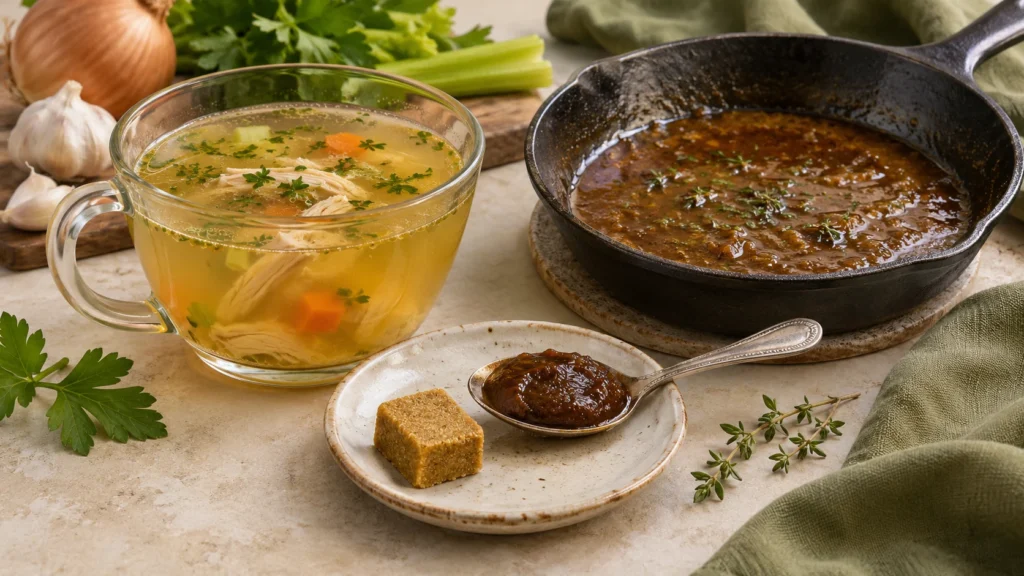
Choose chicken bouillon or stock concentrate by the directions on the actual product. Either may be a strong flavor base that needs dilution. A cube can be simple to count, while a paste or liquid can be measured in smaller increments. Compare the amount needed for the same volume of prepared broth and check sodium and ingredients. In a soup, start with the intended dilution. In a skillet sauce, taste after reducing before adding salt.
Read concentrate directions before substituting
| Situation | What to do |
|---|---|
| Broth from a cube | Use the product’s specified water volume. |
| Paste or liquid base | Measure for the final volume and recipe. |
| Reducing sauce | Taste near the finish before adding more salt. |
Read the label as a recipe
The words bouillon, base and concentrate can describe overlapping products. Some come in cubes or powder, others in paste or liquid. A stock sold in a carton may be ready to use or may require water. Read the preparation directions instead of taking the product name as evidence of its strength. Note the amount of concentrate, final liquid volume and whether storage changes after opening.
A cube can be useful when the recipe needs a volume that matches the package. A measured paste can be easier if you want only part of a standard serving. Try dissolving a partial serving in warm water according to the directions before adding it to the skillet. That makes it easier to stir evenly and avoids a concentrated salty spot.
Compare sodium at an equivalent prepared volume. A label can show nutrition per cube, per teaspoon or per serving of broth. Use its directions to determine how much broth each serving makes before comparing. Also check the ingredient list for things that matter to you, including allergens, animal ingredients and seasonings. A “stock” label alone cannot tell you whether a product contains less sodium or tastes richer.
Use product-specific amounts rather than a universal conversion
For example, Better Than Bouillon’s Roasted Chicken Base gives one teaspoon dissolved in eight fluid ounces of boiling water as its broth preparation. The proportions belong to that product. A bouillon cube from a different manufacturer can be written for another amount. Keep the original packaging so the next cook can check both the dilution and storage directions.
Suppose you need two cups of broth. Using a product that makes one cup per teaspoon, two teaspoons would make the label-strength broth. If your cube makes two cups per cube, one cube would provide the same prepared volume. These are examples of reading directions. They do not establish that the two products have the same flavor or sodium. Taste the prepared amount and decide whether it suits the recipe.
If a recipe calls for stock by volume, prepare the replacement first. If it calls for concentrate itself, use the amount and product strength the recipe assumes or adjust with care. Direct substitution of undiluted concentrate for stock can make the dish much stronger. Adding a full cube to a small amount of liquid has the same problem unless the recipe specifically uses it that way.
Work one soup example
For a two-cup soup base, prepare the liquid as the label directs. Add the vegetables, herbs and chicken according to a recipe that fits the quantity. If using raw chicken, cook it to 165°F (74°C). If using safely stored cooked chicken, reheat it to 165°F when serving hot. Check the temperature of the chicken itself and observe the soup recipe’s finish.
Taste a sample near the end, after noodles, vegetables and meat have changed the balance. If the soup is too strong, add a small amount of unsalted compatible liquid and taste again. If bland, add a little prepared base or another seasoning only after tasting. Wide pans lose water more quickly than covered pots, so keep the recipe’s expected consistency in mind.
For a soup you plan to freeze, keep the label directions and note the amount you used. Cool it promptly in shallow containers. You can adjust it again after reheating safely if the starch or added ingredients changed the consistency. Avoid adding a full extra amount of base before you know how the soup will taste.
Work one skillet sauce example
For a skillet sauce, begin with the liquid volume and concentration specified in the recipe. If reducing a cup to half its volume, much of the salt stays in the pan as water evaporates. A broth that tastes quite salty at the start can be less forgiving after reduction. If the recipe allows it, start with a milder mix or use an unsalted liquid for part of the volume. Measure the starting amount so you can repeat the result.
Cook the sauce to its intended texture. Taste near the finish before adding salt or a second concentrated ingredient. If it is too salty, dilute with an appropriate unsalted liquid and adjust the texture as directed. If the chicken has already reached temperature, lift it to a clean plate while you fix the sauce.
Choose the form by what you use most
Keep cubes if you regularly make a pot that fits their standard volume. Use a measured paste or liquid if you often make small amounts. Follow the product’s storage directions after opening. Write down the prepared amount you like for soup and the milder strength that works in a sauce. The same product can work in both if you measure and taste at the right stage.
Compare products before seasoning the main pot
Prepare a small amount of each liquid at its maker’s directions when choosing between products. Compare the same volume in two clean cups. Note which one tastes strongest, then decide what will happen after the recipe’s other salty ingredients are added. In a soup with salty cooked chicken or noodles, you may want a milder base. In a skillet with browned bits and a small amount of liquid, the reduction can add enough flavor without a strong mix.
Write the product name and dilution on your recipe note. If a form is changed later, check the new package again. Two jars that look alike may give different directions. If you split a large soup batch, adjust one small portion first so that you can compare how the correction tastes before changing the entire pot. A partially used base should go back into storage as the maker directs.
When comparing sodium, check whether numbers are for the concentrate itself or for a prepared serving. For example, if each serving shown makes a different amount of broth, convert both to the same prepared volume before comparing the numbers. Keep the actual serving size in mind if you plan to eat a large bowl.
Sources
Frequently asked questions
Are bouillon and stock concentrate interchangeable?
Check each label and match the prepared volume and strength before substituting.
How many cubes make one cup?
Use the directions for your product. Cube sizes and dilution vary.
Should I add salt before reducing a sauce?
Taste near the end. Reducing concentrates the salt already present.
Can I compare sodium per cube and per teaspoon?
Compare sodium for the same prepared volume, using the label’s dilution directions.
What if my stock concentrate is too strong?
Dilute with a suitable unsalted liquid and recheck the flavor and recipe consistency.
Which is better for a small skillet sauce?
Choose a form you can measure accurately in a small amount.


