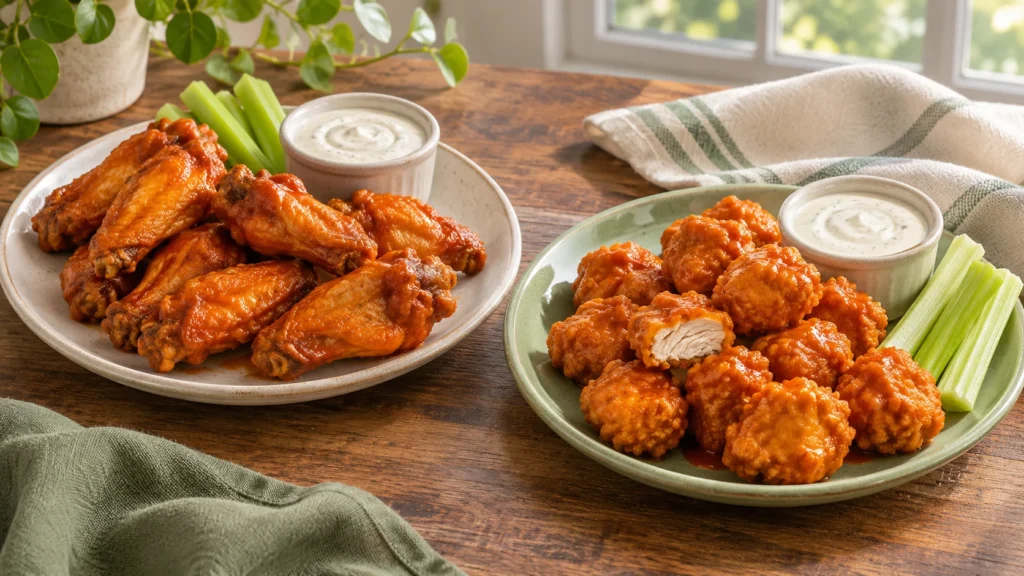
Bone-in wings are actual chicken wing parts. A product sold as boneless wings may instead be pieces of breast meat or another boneless chicken product with a coating. Read the product description and ingredients to learn what is inside, then check whether it is raw or fully cooked. Choose a wing recipe for actual wing sections, or a recipe or package method for the specific boneless product. Compare edible servings, not just the number of pieces or the price per pound.
Choose by the product label
| Situation | What to do |
|---|---|
| Whole or split wing | Count pieces and use a wing recipe. |
| Breaded boneless product | Check the cut or construction and raw status. |
| Serving cost | Divide actual package price by comparable portions. |
Read the product name and the description together
Start with the description close to the package name. A pack of whole wings may include the drumette, the flat and the tip. A pack of split wings can contain the first two sections in varying proportions. Count pieces the way you will serve them. A whole wing that you plan to separate yields a different count from a bag already divided into sections. Wing tips have a different role from the meatier parts and may be saved for stock if handled safely.
Boneless wings describe a serving format rather than guaranteeing an anatomical cut. An example from Tyson Foodservice is sold as uncooked chicken breast chunk fritters in its boneless wings and chunks range. Its name identifies the meat and its raw status. Another package can contain cooked pieces or a product made with formed chicken. Look at the actual wording instead of assuming every brand uses the same construction. If comparing fresh raw breast you will cut yourself with a finished frozen product, allow for the extra steps you will do at home.
Read the ingredient list as well. A plain package can have fewer components than breaded frozen bites, and some poultry products contain added solution. Use the exact label to see whether the pack includes water, other ingredients, seasoning or sauce. For an allergy or other restriction, check the complete ingredient declaration on the current product. A sauce pouch, binder or breading may introduce ingredients you would not expect from the main name.
Check raw or cooked status before you plan a method
A golden or crisp-looking coating is not proof of cooking. USDA explains that some breaded boneless poultry products look browned before they are ready to eat. Look for terms such as uncooked, raw or fully cooked and for safe-handling and cooking instructions. Keep the package for any portions you return to the freezer. If you no longer know the product or its instructions, do not use a time from a different bag.
Follow the directions for the exact appliance and load. A raw frozen product may be written for a conventional oven from frozen. Do not change to a microwave or air fryer unless the product instructions support it. Chicken must reach 165°F (74°C). Use the thickest part of the meat and keep the probe clear of bone. If pieces vary in size, check several, especially the largest ones. For thin pieces, a side entry can place the sensor in the middle.
For uncoated raw wings, follow a recipe that matches the cut and whether you are cooking whole wings or sections. Avoid handling ready-to-eat sides with tools used for raw poultry. Put cooked pieces on a clean platter and use clean tongs. If you want to toss the wings in sauce, keep a clean portion of sauce separate from anything used in preparation.
Compare the amount people will actually eat
Price per unit weight helps compare packages of the same type. Crossing from bone-in wings to breaded boneless bites changes what that weight measures. Bone is part of the raw weight of the wings. Breading contributes to the weight of the bites, even though it is edible and may be part of the appeal. Decide whether your comparison is about appetizer servings, edible cooked weight or the amount of chicken meat. Those are different measurements.
A simple test uses the portions you actually serve. Weigh the package before cooking if helpful, then record the cooked pieces and the number of people who ate them. For a meat-only comparison, you would have to exclude bones and distinguish coating from meat. For a party budget, cost per actual serving can be more useful. Divide the amount you paid by the number of comparable servings the package produced. Include sauce that you bought separately if it affects the decision.
If the serving is meant to be an appetizer alongside a meal, allow fewer pieces than if the chicken is the main. Match sizes and number of sides. A four-piece serving of small flats is not necessarily equivalent to four large breaded bites. A trial pack makes it easier to plan a gathering than a single universal yield percentage. Record the actual product, formulation and package weight so the estimate is useful next time.
Select the recipe that fits the format
For bone-in wings, browse the HCCR Buffalo wings collection for a method suited to wings. Compare that with the garlic Parmesan wings option when you want a different finish. Read the recipe before buying, including whether it expects split or whole wings and what cooking appliance it uses. Keep sauce and crispness in mind. Add sauce late if the method is built that way, or serve it separately when you want the coating or skin drier.
For boneless bites made from raw breast, use a recipe written for bite-sized, evenly cut pieces and the coating you plan to make. Bone-in breast and thigh recipes can help you compare how larger bone-in cuts are handled. They do not establish the cooking time for a small chunk. If you bought a breaded packaged product, its own instructions set the preparation method. Choose a side and clean dipping sauce while that batch cooks.
For serving, bone-in pieces need room for bones and possibly extra napkins. Boneless pieces may be easier to portion into bowls or serve with dips. Keep the raw and cooked stations separate for both formats and refrigerate leftovers promptly. Think about the table and appliance before deciding that one format is automatically easier. A large tray of split wings may work well in your oven, while several packages of small bites may require more batches than expected.
Make a shopping decision you can repeat
Before putting the package in your cart, confirm four things: the actual meat, the coating, the raw or cooked status and the cooking directions. Then check how many diners you have and what else will be on the table. If your planned recipe and product disagree, change the recipe or buy the cut it calls for. A label photo and a note with the number of portions can save work for your next party.
Compare two packs with your own serving count
Suppose you are choosing between a tray of split raw wings and a bag of coated breast chunks for a small group. First check the directions, because the wings might need a baking tray while the frozen product might specify a different oven setup. Count the same number of diners for each plan. For the wings, allow for bones and pieces with different amounts of meat. For the chunk product, treat the coating as part of the appetizer and check whether the label describes whole-muscle or formed pieces. Do not compare the bone-free weight from one pack with the total edible weight from another if your goal is to compare amounts of meat.
For a quick buying decision, use actual prices rather than a typical or national price. Take the number of servings you observed after cooking a trial pack and divide the package price by that count. Write down the sauces and sides that were part of the meal. For a future party, the serving count and pan capacity will usually be more useful than an estimate from the photo on the bag.
Sources
Frequently asked questions
Are boneless wings actual chicken wings with the bones removed?
The term can describe a prepared format. Check the product description to find out whether it uses breast pieces or another boneless product.
Does every wing pack contain the same number of flats and drumettes?
No. Check whether it contains whole wings, split sections or a particular section, and count the pieces you plan to serve.
What changes if the pack has different ingredients or weights?
Recheck the coating, added ingredients, instructions and cost per comparable serving. The weight may include bone, coating or added solution.
Can a frozen breaded bite be raw?
Yes. A browned exterior does not establish that it is fully cooked. Read the label and verify 165°F for raw chicken.
Which is easier for a party?
Boneless bites can be easy to portion. Bone-in pieces may work well with a wing recipe and suitable platters. Check batch capacity for both.
Can I use a wing recipe for breaded frozen bites?
Use the package cooking method. You can serve a clean wing-style sauce separately if it fits the product.