
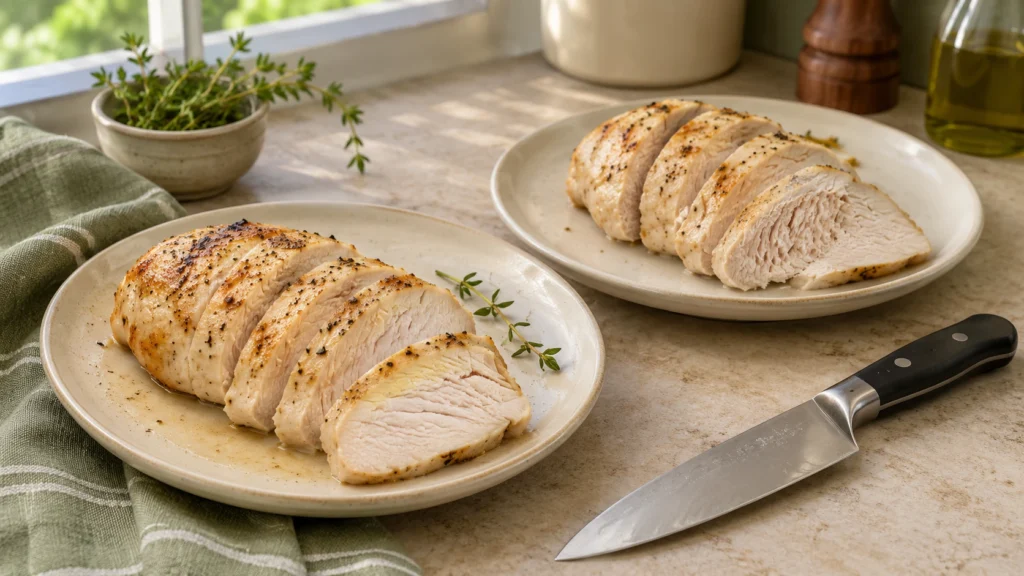
A woody chicken breast can remain unusually hard, crunchy or fibrous even when safely cooked. If a firm patch is concentrated in one part of a breast while a similarly cooked piece stays tender, a meat-quality defect is a possibility. Overcooking usually produces more widespread dryness. Compare the pieces and their cooking records before changing your technique; check poultry doneness separately with a thermometer at 165°F (74°C).
Identify the firm patch and compare two pieces
You cut into a chicken breast that looks appetizing from the outside. The first bite is surprisingly resistant, almost as if there were a dense seam inside the meat. The next breast from the same pack is tender. This is a different problem from a dinner where every fillet is uniformly dry. A localized texture difference may reflect how the muscle developed rather than an error that affected the entire pan.
Woody breast is a recognized quality condition in broiler breast muscle. Research involving normal, mildly affected and severely affected fillets found that hardness can differ substantially between locations within the same fillet, including after cooking. Changes in the muscle structure and connective tissue are implicated. The important point for the home cook is that the condition exists before cooking; improving the cooking process cannot necessarily restore that structure. A laboratory classification is not something you can reproduce simply by looking at a cooked slice.
Begin with two breasts that were cooked at the same time. Identify the thicker end of each and cut across the muscle fibers on a clean board after confirming doneness. Compare their thickness, the resistance of the knife and whether the unusual texture occurs in one region or everywhere. A piece that has a firm, almost crunchy part immediately next to a normally textured part gives you a useful clue. A breast that is uniformly chalky with a dry, brittle edge gives you a different clue. Neither observation is proof by itself.
A useful side-by-side record
Record each piece separately. If piece A was thicker, was it in the hotter spot of the pan? Did piece B come out first? Did the thermometer pass through the thickest section of both? If you cannot answer those questions, you have not yet controlled the cooking variables well enough to blame the package. Even two pieces from one tray can experience different amounts of heat. Use the comparison as a way to narrow the possibilities, not as a definitive diagnosis.
Quick diagnosis: match the symptom to the next step
| What you notice | Likely explanation | Next step |
|---|---|---|
| Firm patch in one breast | Starting muscle quality may differ | Compare equally cooked pieces; change pack if recurring |
| Dry edge and chalky center | Extended heat exposure | Check pieces separately and remove when safe |
| Resistance only in long slices | Grain direction | Slice across fibers and compare the bite |
Use cooking records to rule in technique problems
Chicken breast is naturally lean. Long exposure to heat can cause its proteins to change and the muscle to lose water. A small breast left in the oven until a much larger one finishes may taste dry and chewy even if the initial raw meat was completely normal. An uneven cut also means that the thin tail may be much drier than the thickest end. In both cases the pattern of the problem follows the distribution of heat rather than necessarily the structure of the muscle itself.
Your most useful evidence is the temperature at removal, not merely the recipe time. Insert a clean instant-read thermometer into the thickest portion and avoid touching bone or the cooking surface. Check each fillet, especially when their sizes differ. Once each reaches the safe minimum, remove it rather than waiting for the rest of the pan to finish. If you repeatedly reach a much higher temperature before checking, adjust the checking point on your next attempt.
Here is a hypothetical comparison. Two similarly thick cutlets are seasoned alike and cooked in the same skillet. Both are checked individually and removed after they reach the recommended safe temperature. One cuts easily all the way through; the other has a stiff region near its broad end. The difference makes a quality issue worth considering. Now imagine the second cutlet is much thinner and was left on the heat alongside the thick one. That comparison cannot separate overcooking from starting meat quality. Change just that difference in the next batch before drawing a conclusion.
What to do with the meat you have
If the chicken was safely handled and cooked, an unpleasant texture alone is not a reason to assume it contains harmful bacteria. Cut away an objectionable patch if the remaining meat is palatable. Thin slices across the grain or small chopped pieces in a saucy dish may make mild toughness less noticeable. Do not force severely resistant pieces into a meal: chewing a hard patch is unpleasant and extra cooking may simply dry the surrounding muscle. If storage or doneness is uncertain, resolve safety first rather than trying to rescue texture.
If several breasts in a package have the same objectionable defect, keep the label and purchase information and contact the retailer about its quality or return policy. Describe what happened without claiming that the package has a confirmed scientific diagnosis. A photo may help explain the problem, but a picture cannot establish safety or prove that a particular fillet has woody breast. The seller may be able to offer a replacement or record recurring complaints.
For your next meal, compare the options in our chicken thigh recipes collection and select a method that fits the texture you want.
Choose a different pack or cut next time
At the store, choose a pack with pieces of reasonably similar size and use intact packaging kept cold. Large, unusually firm fillets can be a clue to quality variation, but there is no reliable home shopping test that guarantees freedom from woody breast. Labels such as organic, antibiotic-free or premium are not a validated screening tool for this condition. Try another pack or supplier if you encounter the problem repeatedly; do not conclude that every breast from a brand is affected based on a single meal.
For a fair cooking comparison, select two similar fillets and use the same seasoning, pan and cooking approach. Record which piece came from which pack before cooking, then cook them without letting the thinner one wait for the thicker. If the next pack behaves normally under the same process, you have a useful practical result, though not proof of the earlier defect. If both remain dry, review heat exposure and the cut shape before switching suppliers again.
If the meal can use dark meat, thighs are an alternative. They have a different fat and connective-tissue profile and suit dishes that need sustained moist cooking. They will not have the same lean, clean-slicing character of breast, so choose them for the dish rather than treating them as an identical substitute. For a sandwich or salad that needs neat slices, a smaller even breast or a tenderloin may suit the presentation better. Match the cut to the intended bite.
Why a marinade is not a quality guarantee
Seasoning, salt and a marinade can change flavor and some aspects of water retention. They cannot be assumed to reverse substantial structural changes already present in the meat. A strong acidic or enzyme-rich marinade can create a second problem: an overly soft surface next to a firm interior. Instead of increasing acid or time aggressively, use the recipe's normal preparation and compare a new piece. This avoids masking the information you gained from your side-by-side check. Keep any marinating chicken refrigerated and never use raw poultry marinade as an uncooked serving sauce.
Keep a small kitchen comparison log
Write down pack date or lot information if available, cut thickness, method, temperature measured in each piece, and where the unusual patch appeared. Also note whether you sliced across the grain and how soon the chicken was served. The log need not be elaborate. Its purpose is to separate repeated patterns from a one-off result. Next time a similar symptom happens, you can see whether it followed the same pack, the same location in the pan or a similar piece shape. That is more actionable than trying several new techniques at once.
For broader method and preparation guidance, use our chicken cooking guide.
Sources and references
- FoodSafety.gov — Safe minimum internal temperatures — Thermometer and poultry / stuffing / leftovers safe endpoint.
- Arkansas Agricultural Experiment Station — Woody breast detection — Woody breast is a meat-quality defect; search excerpt reviewed.
- Assessment of meat quality distributions of breast fillets with woody breast condition — Uneven hardness and changes in meat quality in affected fillets.
- Measuring water holding capacity in poultry meat — Water retention, muscle structure and cooking losses.
- USDA FSIS — What is the safe way to marinate poultry? — Refrigerated marinade up to two days; discard or boil raw-used sauce.
Frequently asked questions
Can marinating reverse a firm patch?
Not reliably. A normal marinade can improve flavor and sometimes the eating experience, but a structural meat-quality defect is not equivalent to ordinary dryness. Trying a stronger marinade may soften the surface excessively while the deeper portion remains firm.
What cooking records help tell the causes apart?
Note the size and thickest point of each piece, cooking method, position in the pan, temperature when removed and location of the firm area. Similar cooking results with localized texture differences make meat-quality variation worth investigating.
Does tough meat prove chicken is undercooked?
No. Cooked poultry can be tough for several reasons. A temperature reading in the thickest part, taken with a food thermometer, is the appropriate check for safe doneness rather than chewiness or color.
Is woody breast the same as white striping?
They are separate quality descriptions that can occur together. Visible pale lines on a raw breast do not establish that the meat has woody breast, nor do they tell you whether it is safe. Treat the appearance as a possible quality clue only.
Can a woody breast be saved by slow cooking?
A moist dish and small pieces can make a mild texture defect less noticeable, but a long cook is not guaranteed to reverse the structural changes. If the meat is already safe and dry, continued heating may worsen it.
Should I throw away a whole pack if one breast is hard?
Not solely because of texture. Evaluate handling and doneness independently and assess the other pieces individually. If a pack has an objectionable quality problem, ask the retailer about its return policy.


