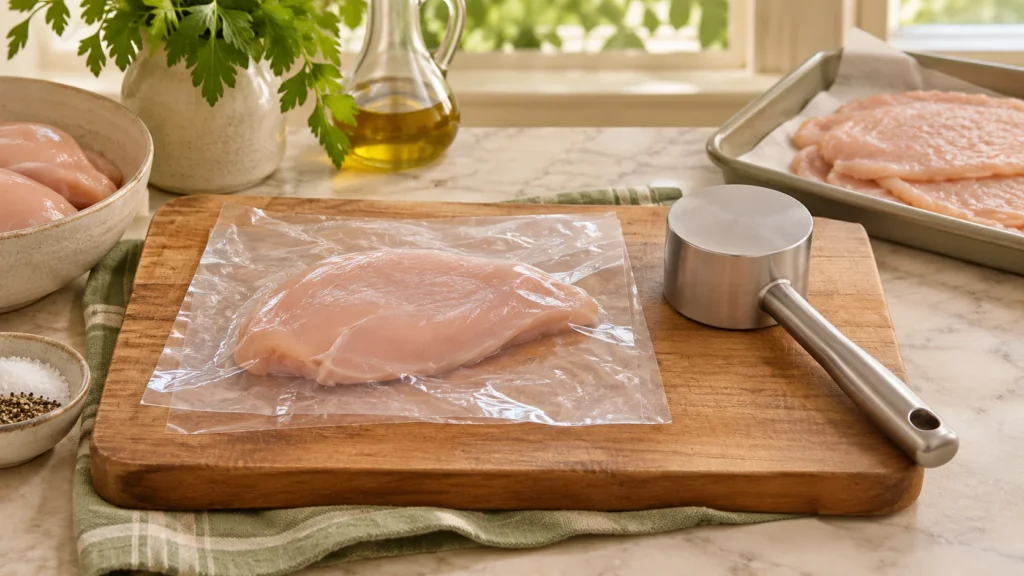
Use the smooth face of a meat mallet and place the chicken between food-safe sheets on a stable raw-prep board. Tap the thickest area gently and work outward. Check thickness after a few strokes and stop when the cutlet matches the recipe. If a breast is very thick or sharply tapered, slice it into cutlets first.
Choose the starting piece and target thickness
Check the recipe for the cutlet thickness it expects. A thin cutlet meant for a quick sear has different needs from a piece that will be rolled. A whole breast often has a thick bulge and a narrow tail. Trying to flatten that entire shape by hitting it hard can damage the tail before the middle has moved. Slice or butterfly the thicker part as the recipe directs before you start pounding.
Use a sharp knife and a stable board if the breast needs to be sliced. Keep your hands positioned safely and cut on equipment dedicated to raw poultry for this task. If you buy precut cutlets, check whether they actually need pounding. Some pieces already match the recipe. Avoid creating extra work or thinning a piece that is already ready.
Fix common problems when flattening cutlets
| Situation | What to do |
|---|---|
| One end towers over the other | Begin with light strokes on the thick area. |
| Edges start feathering | Stop striking the edges and work farther inward. |
| Large thick breast | Consider slicing it horizontally before flattening. |
Choose a smooth mallet and a suitable barrier
A flat, smooth mallet face distributes the force more evenly. A textured face is designed for a different effect and can mark delicate raw pieces. Use a tool meant for food preparation and check that its surface is clean. Choose a barrier suitable for food contact, such as food-safe sheets or a suitable clean food-storage bag. Keep the chicken flat and allow room for it to spread.
A barrier helps contain splashes but cannot substitute for cleaning. Discard single-use material that contacted raw poultry. Wash the mallet, board and any surface that may have been contaminated. Do not rinse raw chicken. Prepare any ready-to-eat vegetables separately and put them away before working with raw meat.
Work from thick to thin
Position the thickest part so the board supports it. Use light, controlled taps and move gradually toward the edges. Do not focus hard blows in one spot or strike already thin areas simply because they are beside the thicker section. Lift the top barrier as needed and look at the cutlet from the side. Stop when it is even enough to cook as the recipe expects.
If the surface starts to split, stop and check how much more the thick area needs. You may be able to cut the piece into separate portions to cook on their own schedules. Keep pieces flat as you transfer them. If they stick to the barrier, peel the material away gently rather than pulling the meat. Start with a piece of comparable size on your next try and compare the number of taps it needs.
Keep the board and tools from moving
Put the board on a flat counter and use intact non-slip feet or a suitable clean anti-slip mat. Test stability before raw food goes on it. A loose board creates a different sort of problem from a tearing cutlet. Use a board large enough for the piece to spread without hanging over the edge. Keep your working hand away from the mallet's path.
Lay out a raw tray for the pieces that need further preparation and a separate clean plate for finished chicken. Set out seasoning in separate containers before handling poultry so raw hands do not touch the original jars. When the cutlets are ready, move them with raw-designated utensils and clear the board promptly. Keep the clean serving tools in another area.
Match the cook to the finished shape
Even cutlets can cook quickly. Follow a recipe for their actual thickness and check the center early. Use a food thermometer to verify 165°F (74°C). On a thin piece, insert the probe sideways so the sensing area stays in the meat rather than touching the hot skillet. Remove pieces promptly when ready and use clean tongs and a serving plate.
If one small cutlet has torn but remains safely handled, cook the smaller parts separately using a suitable method. They may work for a salad or sauce even if they no longer make a neat sandwich cutlet. Keep waiting pieces refrigerated until needed. Do not stack thick portions beside very thin scraps and assume they will finish together.
Compare an uneven breast with a precut pack
A whole breast might need a careful horizontal cut followed by a few taps on the thicker ridges. A pack of thin pieces may need only a check of one bulge, or no pounding at all. Cook the pieces by an appropriate method and see whether their centers reach the endpoint at similar times. If the narrow end dried out even after gentle pounding, look at slicing and grouping rather than trying a heavier mallet.
Plan the next step before you start pounding
Lay out the number of cutlets you need and decide how they will go into the pan. If one breast yields a broad piece and a much narrower piece, place the thinner one at the edge of your work area so you remember to use less pressure on it. A very thick whole breast often benefits from being cut horizontally first. Cutting the thickness in half before pounding also gives you two portions that are easier to handle and cook evenly.
For breaded cutlets, prepare the breading station before handling raw poultry. Use bowls or containers wide enough that a cutlet can lie flat. If the coating has gaps, check whether the chicken folded when you lifted it, whether there were wet spots on the surface or whether the bowl was too small. Keep a clear place for the prepared pieces and wash your hands before handling seasonings or the stove controls.
When cooking, lay each cutlet flat and leave room around it. If one has a thinner tip, it may brown sooner than the other end. Check its center early and move finished pieces to a clean plate. Keep a note of whether cutting the breast first or pounding it whole worked better for the pan you used. Use that pattern for the next batch.
Sources
Frequently asked questions
Which side of a mallet should I use?
Use the clean smooth face for gentle flattening.
Should I pound a whole breast flat?
A very thick or tapered breast is often easier to slice or butterfly first as the recipe directs.
Why does the edge tear?
It may be much thinner than the rest or getting too much force. Start at the thick part and check often.
Can I reuse the barrier?
Discard single-use items that contacted raw poultry and wash reusable equipment appropriately.
What if the cutlet tears?
Cook the smaller pieces separately using a suitable method if their handling was safe.
What is the safe internal temperature?
Check 165°F in each cutlet, inserting from the side when useful.