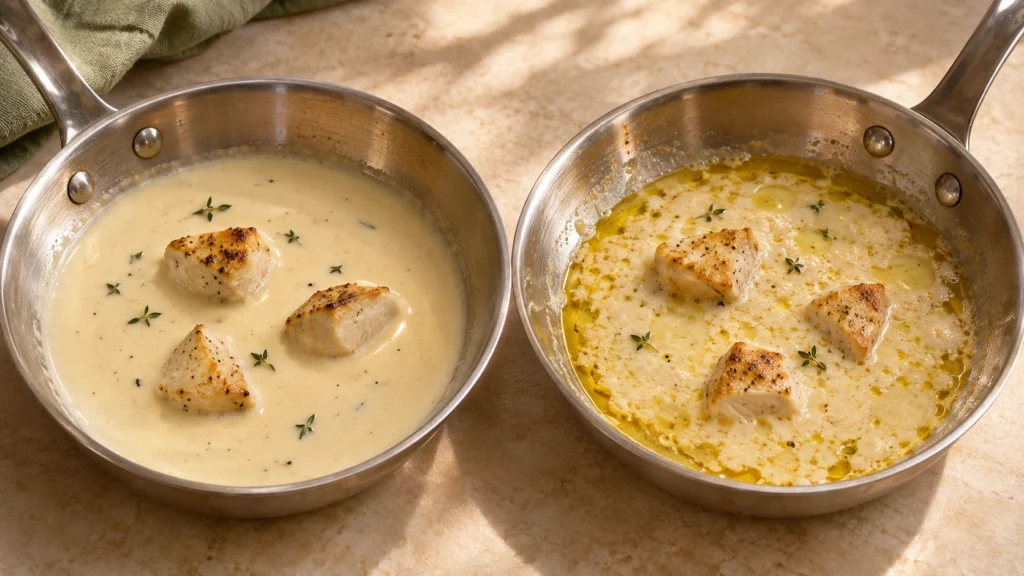
When creamy chicken sauce splits, take it off the heat and check whether you see oil, curds or both. A smooth sauce with small oil droplets may come together with gentle whisking and a little compatible warm liquid. Persistent curds are harder to reverse. Test any correction in a small bowl before adding cream, stock or more heat to the whole pan.
Identify what separated
Spoon some sauce away from the chicken and let it stand briefly on a plain plate. An oily break leaves a shiny ring or clear drops around a base that can otherwise look smooth. Curdling leaves irregular pale specks or soft ragged solids floating in a thinner liquid. Both can happen in the same pan, and ground spices, chopped garlic or bits of fond can look like curds from a distance. A white plate makes it easier to distinguish the pale specks of dairy from the darker ingredients.
The sequence matters. A sauce that goes from smooth to dotted after a squeeze of lemon behaves differently from one that was shiny from the moment you added butter. Recall whether the liquid was boiling hard, whether the dairy was cold, and whether the recipe specified cream, milk or yogurt. A lemon cream sauce and a lightly stirred yogurt sauce may use similar ingredients but handle them at different stages. The closer you can identify the change, the less guesswork goes into the rescue.
| What you see | Question to ask | What to try first |
|---|---|---|
| Small oil beads on a smooth base | Did the pan reduce heavily or retain extra drippings? | Whisk a small sample with a little warm base liquid |
| Fine white flecks after lemon or wine | Was the dairy simmering when acid went in? | Stop direct heating and inspect a spoonful |
| Firm curds in thin liquid | Did it boil after adding milk or yogurt? | Plan to remake the sauce if the curds persist |
| Smooth but watery sauce | Is there enough thickener for the amount of liquid? | Follow the recipe’s intended thickening step |
Compare heat, acid and dairy sequence
A creamy sauce can hold fat in tiny droplets in its water-based phase. That uniform look can disappear if the water cooks away or extra fat enters the pan from butter or chicken drippings. Whisking can disperse a small amount of free oil again when enough liquid remains. Milk proteins can also gather into curds under some conditions. Harold McGee’s discussion of cream notes that acidity combined with heat can cause casein to curdle and that heavy cream is more resistant than lower-fat dairy in many sauce applications.
In a wine-based skillet sauce, deglaze and reduce the wine at the step the recipe gives. Lower the heat before adding cream if the directions call for it. If lemon juice is specified as a final seasoning, take the sauce off direct heat and add the juice gradually. A recipe designed to simmer heavy cream with other ingredients can tolerate a different sequence from a sauce finished with yogurt. Gentle heat, gradual addition and good stirring give you more time to notice a texture change.
How substitutions change the outcome
Half-and-half, evaporated milk, sour cream and Greek yogurt each bring different amounts of water, protein and fat. Choose the product named in the recipe for the first attempt. When adapting a recipe for a particular dairy, look for a sauce specifically developed for that dairy and compare how it handles thickening and acid. A purpose-built sauce might use a flour base to help stabilize milk or have you loosen yogurt with a little warm sauce before incorporating it. Simply pouring cold yogurt into boiling lemon stock can undo that preparation.
Consider how much rendered fat the chicken left behind. Pan-seared skin-on pieces can leave a deeper layer of drippings than lean boneless breast. Pour off excess as the recipe directs before you build the sauce, keeping the browned fond for flavor when appropriate. Measure the butter after that step. A cream sauce can suit a whole skillet of chicken while still needing only the amount of fat the recipe was developed to hold.
For a sauce with a different fat and seasoning balance, see Buttered Chicken.
Try the least disruptive rescue first
If the sauce appears oily but contains few or no solids, move a few spoonfuls to a warm mixing bowl. Whisk while adding a little warm liquid that belongs in the recipe. For a broth-based pan sauce, unsalted stock may work. For a sauce concentrated by reduction, warm water can replace some of the lost moisture without changing the flavor as much as a strongly seasoned broth. Check whether the gloss becomes even and whether a free oil ring forms again after several moments. Scale the correction gradually only if the trial holds.
A pan with distinct curds needs a different decision. Straining a small sample can tell you how much body would remain after taking the solids out, but it cannot restore the original texture of the separated proteins. Blending may make some soft curds look finer while leaving the taste and feel changed. If the sauce still feels coarse, make a fresh base in a clean pan and use the cooked chicken with it. A sauce that smells scorched adds a separate problem. Leave any burnt film on the bottom undisturbed and start again if the burnt flavor carries through the sauce.
An example from a lemon chicken skillet
Imagine chicken breasts are already cooked and the sauce is smooth until lemon juice is stirred into a strongly bubbling mixture made with milk. White specks appear almost immediately. Move the pan off the heat, set the cooked chicken aside on a clean plate briefly, and assess the sauce away from the meat. If the particles remain after a small whisked trial, rebuild the sauce using the recipe’s specified cream or a recipe designed for milk. Add lemon at the finish if the method calls for it. Holding every other variable steady makes it easier to learn how the dairy and acid interact.
Finish the chicken and keep the sauce stable
Check the thickest part of the chicken with a thermometer before treating it as ready to serve. The USDA minimum is 165°F (74°C) for poultry. If a piece is still below that temperature, keep cooking it in a clean skillet or appropriate vessel while you handle the fragile sauce separately. Use clean utensils and a fresh plate for fully cooked pieces. The sauce can then be spooned over the chicken just before eating. Refrigerate leftovers promptly and reheat them to 165°F (74°C), adding a little compatible liquid if needed for texture.
For more single-pan examples, browse Skillet Chicken Recipes.
Treat a stable but thin sauce differently
A smooth cream sauce with no separate oil and no curds may only need the method to finish. Draw a spoon across the bottom of the pan. If the liquid runs back immediately and looks uniform, consider whether the recipe expected a brief final simmer or already relies on flour or starch. You can use a sample to see whether a little more cooking gives it the intended coating. If the recipe contains lemon or wine and low-fat dairy already went in, choose gentle heat and watch closely for the first change in texture.
Consider the serving surface too. A sauce that pours easily over chicken and gathers on mashed potatoes can work well at a consistency that would seem thin on pasta. Judge it with a bite sized for the plate. Adding more fat or starch to achieve a particular appearance in the pan can mask a good flavor or make the finished meal heavier than you intended.
If you are serving the meal in stages, finish the sauce in smaller batches. Repeatedly taking a fragile sauce from cooling to bubbling gives you more chances to lose water or curdle the dairy. Reserve the measured base safely and follow the recipe’s finishing step for the portions you will serve.
For more on thermometer use and storing cooked chicken, see the HCCR chicken food safety guide.
Sources and references
Frequently asked questions
Can more cream fix a separated sauce?
Sometimes a small amount helps a sauce whose fat has begun to separate. It also changes the fat and liquid balance and can dilute seasoning. Test on a spoonful first. Cream will not dissolve firm dairy curds.
When should the acid go in?
Follow the recipe. Wine for deglazing usually goes in before dairy, while lemon for fresh flavor often goes in near the end, away from direct heat. Add a finishing acid gradually and watch what happens to the sauce.
Can every split sauce be fixed?
An early oily break may respond to controlled whisking and a little warm liquid. Firm curds or a scorched flavor are much harder to correct. A new sauce can preserve the rest of the meal.
Why did my sauce split when I reheated it?
Extended heating can reduce the liquid further and encourage separation. Reheat small portions evenly, stir during heating, and use a thermometer to verify the leftovers reach 165°F (74°C).