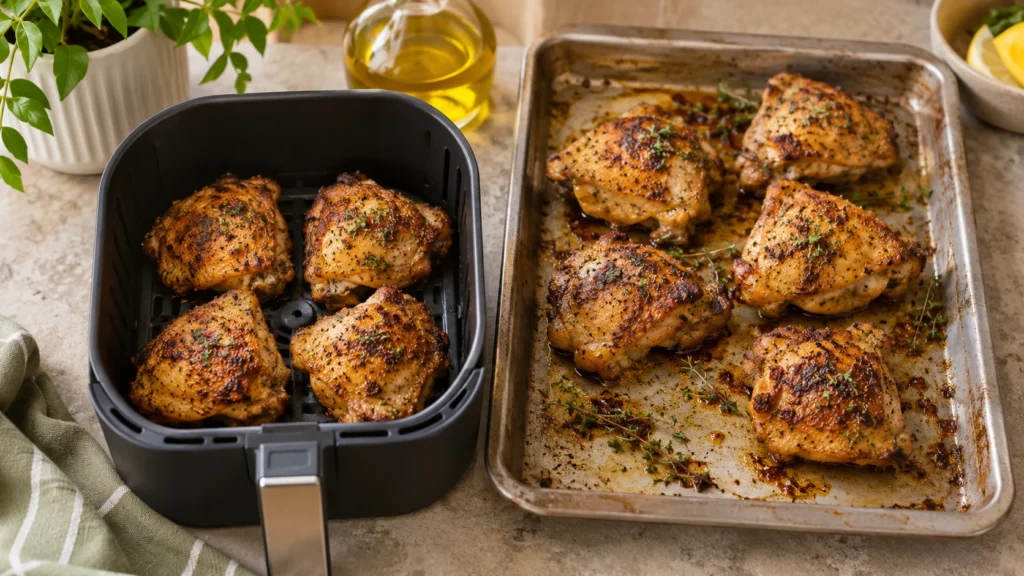
Use the air fryer when the chicken fits in one properly spaced basket and you want a small batch with a browned surface. Use the oven when a larger tray lets you cook the whole meal in one round. Compare preheat, every cooking cycle, turning and the time the first pieces wait. In either appliance, verify 165°F (74°C) in the thickest part of the chicken.
Count the pieces that fit, not just the basket volume
Set out the number of pieces the recipe specifies. Compare the footprint of one piece with the basket or tray. If the chicken is raw, use a dedicated prep surface rather than putting food straight into the appliance just to test its fit. Allow the spacing the recipe and manufacturer specify. A deep basket with a modest floor area cannot cook extra thighs as efficiently merely because there is room above them. Touching pieces have fewer exposed surfaces and can be harder to turn safely.
An oven pan generally offers more floor area, although the usable area shrinks if you need space for vegetables or if the pan has a high rim. If you have two racks and want to roast two pans, check the recipe and appliance guidance on positions and whether they expect rotation. A fan may improve circulation, but pans still block some air and can brown differently on different racks.
| If dinner looks like this | Start here | Check before cooking |
|---|---|---|
| Two small thighs and an otherwise ready meal | Air fryer | Pieces fit without crowding |
| A family tray of several large pieces | Oven | All pieces have space and the rack fits the tray |
| Chicken with vegetables that need different times | Oven tray or two cooking rounds | Plan the start and finish of each food |
| A breaded batch with a specific rack position | Follow the recipe’s equipment | Check how turning and airflow affect the coating |
Compare total time and attention
A small air fryer can heat its chamber quickly, but preheat depends on the device and recipe. Some directions assume a warm basket and some start cold. An oven may take longer to come up to temperature and still win if it cooks all the pieces together. Write down the entire sequence before choosing. Include turning, checking temperature, unloading, restoring basket space, and holding the early portions. Consider what else you need to do during those steps. A busy cook may prefer one oven cycle even if it takes slightly longer on paper.
For example, imagine a basket that holds three thighs. Your recipe calls for a 17-minute cook for that size and your device needs three minutes to preheat. Six thighs require two cycles, so you have 37 minutes before adding the batch change and checks. If a compatible oven recipe hypothetically needs 12 minutes to preheat and 29 minutes for all six, its 41 minutes can be similar. These are planning numbers, not cooking instructions. Use the actual recipe, equipment and thermometer. For nine thighs, the extra basket cycle changes the comparison again.
Track what happens at serving time
A first basket can be ready before the sides. If it needs to wait, plan a suitable short hold or serve in rounds. A closed cover can soften a crust by trapping steam. If holding cooked chicken hot, use a method that maintains at least 140°F (60°C). When you cannot keep food hot enough, follow USDA time limits and refrigerate any portion you are saving promptly. The best choice for serving everyone together may be a tray that finishes the pieces in one cycle, even though the first basket could have reached the table sooner.
For exposed oven browning, compare Crispy Oven Baked Chicken.
Compare the finish you actually want
For skin-on thighs, assess how much of the skin remains exposed to heat and whether the recipe calls for finishing skin side up. If you follow an air fryer method that asks you to turn the pieces, check that there is space to lift and reposition them. An oven recipe may call for a rack over a rimmed tray so juices collect below the food. Use the cookware the method was developed around. A deep casserole and a shallow sheet pan can give different results from the same oven.
For a breaded cutlet or tender, check whether the method uses a little oil, a rack or a timed turn. The goal is even color and a crust that stays attached when you move it. The first pieces you place in a basket may be much smaller than the last. Group them by size where practical, and check the thickest representative pieces. If you put a thin piece into a batch of much larger ones, remove it when safely cooked and let the others finish.
Choose for a small serving and a family tray
Suppose you are cooking two thighs for a pair of grain bowls. A basket recipe gives you enough space and lets you heat the chicken while the bowl ingredients are ready. Next week you need six thighs and a tray of potatoes. If the oven recipe accounts for both cut and side, one oven cycle may make timing and cleanup easier. If you use both appliances, assign each a distinct job so you can check doneness without trying to turn food in two places at the same moment.
When switching from one appliance to another, find a recipe for the destination appliance and your cut. A basket-style air fryer and a convection oven both move hot air, but fan strength, tray area and distance from the heat are different. An oven recipe with fan settings may give different timing from a conventional oven. Follow the directions for your equipment and check the thickest portion without touching bone. Do not assume browning tells you when the center is safe.
For more basket methods and chicken cuts, browse Air Fryer Chicken Recipes.
Compare how both methods fit the rest of dinner
A basket that handles your weekly amount of chicken can be a good choice even if it has little space for vegetables. Plan a cold side or cook the vegetables with another method that does not compete for the basket. If you want the convenience of one dish, choose an oven recipe that explicitly schedules the chicken and the vegetables. Roots and quick greens may need different start times. A sheet of mixed food will not necessarily cook evenly if you load everything at once.
If you normally serve dinner at a fixed time, estimate backward from the last batch. Write down the minimum number of rounds and the checks that cannot overlap. For a two-cycle basket meal, you may want to finish the sides before the first round is ready, or arrange them so they can wait safely while the final batch cooks. For a single tray, get the sides ready while the oven heats if they share the same process. That is a more realistic comparison than putting the recipe’s headline times side by side.
Keep the coating in mind when you divide the work. Breaded chicken waiting under a lid can lose the texture you made time to achieve. If you need to cook in rounds, serve a few pieces as soon as they are ready, or use a suitable hot holding method and keep the portions spaced. If the meal is meant to be eaten cold later, prioritize prompt chilling over keeping every piece crisp. Save the finishing sauce separately.
For repeat meals, record the number that fit, how the pieces were arranged, and how much additional time came from turning and checking. If a new pack contains larger pieces, check the load again before assuming it fits. A basket that holds four compact tenders might hold only two wide breaded cutlets. The most useful capacity number is the one connected to a specific cut, size and recipe.
When following a package for breaded raw frozen poultry, use its stated cooking method. For raw, stuffed, breaded chicken breast products, use only a method the package explicitly provides. Do not air-fry a product whose directions specify a conventional oven.
For more on thermometer use and storing cooked chicken, see the HCCR chicken food safety guide.
Sources and references
Frequently asked questions
Is an air fryer quicker if I need two batches?
It can be, but compare preheat and both cooking cycles with the full oven schedule. Include unloading, checks and the wait for early portions.
Which method gives more room around each piece?
A shallow oven tray usually offers a larger cooking surface than a small basket. Count the pieces that fit with the recipe’s spacing and check your own equipment.
Does a fan oven cook the same as a conventional oven?
A fan circulates hot air and can change timing and browning. Follow the recipe’s fan or conventional setting and verify doneness rather than converting by guesswork.
Should I stack chicken to get all of it in one round?
Use the loading pattern the manufacturer and recipe specify. For a browned finish, a spaced layer is a reliable starting point and makes individual checks easier.