
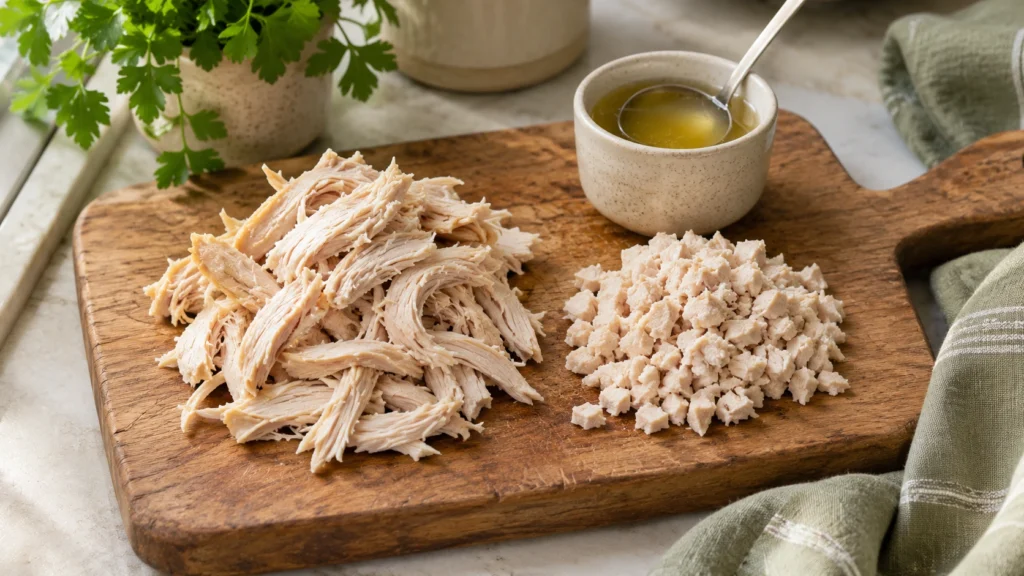
Shredded chicken turns stringy and dry when its muscle fibers lose moisture, resist pulling or are separated into excessively fine strands. Test a small portion before shredding everything. If the fibers pull apart naturally, keep them coarse and coat them with a sauce. If they resist or crumble, chop across the grain instead. Avoid repeated cooking of already safely cooked dry meat.
Inspect the grain and pulling resistance
Shredding changes more than the appearance of cooked chicken. It separates muscle fibers into narrow strands, increasing the surface area exposed to air and seasoning. A well-cooked piece that separates readily can become a juicy taco filling. A breast that has dried during cooking may instead turn into thin strings that feel rough in the mouth. Pulling harder does not correct the starting texture. It often makes the threads longer and thinner, worsening the very symptom you are trying to fix.
Begin with one piece that you have already verified was safely cooked to 165°F (74°C). Place it on a clean board and use two forks to separate a small section gently. Pay attention to how it behaves: does it split into plump, moist bundles with little effort, or does it require strong pulling? Does the piece break into small fragments instead? A large batch does not need to be processed using the same technique if some pieces behave differently.
Look at the direction of the fibers before pulling. Breast muscle has long fibers that can produce long strands. To shorten resistant fibers, cut the cooked piece across the grain before separating it or simply chop it. Avoid shredding the entire batch with an electric mixer before making this test; it is harder to control the size of the strands once everything has been mechanically broken apart. An electric tool may be useful for tender cooked pieces, but high speed and prolonged mixing are unnecessary when the texture is already fragile.
Distinguish three types of shredded texture
Coarse, moist shreds hold their shape and carry sauce between the strands. Fine, dry shreds separate easily but have a fibrous eating quality, especially when piled onto dry bread or rice. Resistant pieces pull apart reluctantly, sometimes tearing into irregular clumps. The first needs little intervention, the second benefits from sauce and less stirring, and the third is often best chopped. Those distinctions are more useful than a rule that all chicken for tacos must be shredded with forks.
Quick diagnosis: match the symptom to the next step
| What you notice | Likely explanation | Next step |
|---|---|---|
| Coarse shreds pull easily | Suitable starting texture | Keep strands coarse and coat lightly |
| Fibers feel dry and threadlike | Moisture loss and fine shredding | Chop shorter; fold into sauce |
| Piece resists pulling | Firm structure or cut | Cross-grain chop instead |
Rescue dry fibers without repeated cooking
For tacos or wraps, coat the strands
Prepare the serving sauce or salsa separately. Add it to the chicken gradually and fold gently. Stop when the threads are evenly coated rather than simmering them repeatedly to reduce excess liquid. A moist filling has to balance the rest of the meal: a warm tortilla, fresh vegetables and a sauce can work together to create a pleasant bite. If a tiny strand falls apart in the sauce, a coarse chopped filling is a sensible alternative.
For a taco filling made ahead, refrigerate the safely cooked chicken promptly in a shallow container, then reheat the portion you need to 165°F (74°C). Do not heat and cool the entire batch every time you assemble a few tacos. Add compatible sauce during the reheating process and verify temperature rather than assuming the tortilla or salsa makes the chicken hot enough. Serving only the amount required reduces unnecessary handling.
For soup or stew, preserve the shape of the meat
Fine strands can disperse through a soup until the chicken is almost indistinguishable from the broth. If you want visible pieces in each spoonful, select coarse shreds or small chopped chunks. Make the broth and cook any vegetables or noodles before adding safely handled cooked chicken. Heat the chicken appropriately, then serve. If the recipe calls for cooking raw chicken from scratch, adapt the order when you substitute already cooked meat; do not give it the full original cooking exposure again.
For a cold salad, use short fibers or chopped pieces
A cold chicken salad should not be one long mass of threads bound by dressing. If the original meat is stringy, chopping across the grain can make the mixture easier to portion and chew. Add dressing and vegetables according to your taste and the intended serving method. Keep the salad chilled and use safely refrigerated cooked chicken. It is not necessary to reheat properly stored ready-to-eat chicken for a cold dish. If you do reheat leftovers for a hot dish, follow the recommended safe temperature.
For chicken that is already safely cooked, use the dry chicken rescue tool to find ways to serve or repurpose it when it turns out dry.
Suppose you made two breasts for lunches and discover one is difficult to shred. The other separates into coarse, moist strands. Use the tender one for tacos where recognizable strands are desirable. Chop the resistant one for a dressed salad rather than working it with a fork for several minutes. You have preserved the best texture of each piece without subjecting either to more unnecessary cooking. That decision can also save preparation time and prevent two meals from sharing the same objectionable texture.
For your next meal, compare the options in our mexican chicken recipes collection and select a method that fits the texture you want.
For a complete recipe to compare against your preparation, see Shredded Chicken Taco Recipes, Chicken Soup Recipe from Scratch. Follow the recipe’s actual cut, size and cooking directions rather than assuming the same timing applies to a different preparation.
Select a cut and method that suit shredding
Chicken breast can produce neat, pale shreds for salads and lighter dishes when cooked carefully. Thighs have a different connective-tissue and fat composition and are often a useful choice for a moist, sauce-forward shredded dish. A recipe designed for a long, moist cook may be better suited to thighs than lean breast, depending on the instructions. Neither cut is guaranteed to remain juicy if you keep cooking long after the desired endpoint. Choose the recipe for the intended result.
Check individual pieces when cooking different sizes in one batch. A smaller breast may reach the safe internal temperature much earlier than a large thigh. If you're making a mixed-cut filling, remove ready pieces or use a recipe that accounts for their different cooking needs. When the meat comes out, consider the final dish before shredding. For storage, keeping safely cooked meat in larger pieces can leave the option to chop or shred later; if the recipe requires immediate shredding, use a gentle tool and stop at the right strand size.
Warm or cold: choose based on the task
Warm meat that has been safely cooked is often easier to separate with forks, especially for a hot filling. Wait only until it is comfortable to handle, not until it has sat out for an extended period. Chilled chicken may be firmer and easier to dice into salad-sized pieces. If using cooked chicken from the refrigerator, use a clean knife and keep its time outside refrigeration short. For leftovers, refrigerate within two hours, or one hour above 90°F (32°C), use within four days, and reheat hot dishes to 165°F (74°C).
One useful test for the next batch
Before seasoning the entire cooked batch, compare a fork-pulled piece and a cross-grain chopped piece. Add the same sauce to both and observe which gives a better bite for the particular meal. This is a suggested kitchen comparison, not a claim that it has been tested here. If the shreds are still dry, review your original cooking temperature and duration rather than automatically adding more liquid. If they were tender before mechanical mixing, reduce the shredding intensity next time.
For broader method and preparation guidance, use our chicken cooking guide.
Sources and references
- FoodSafety.gov — Safe minimum internal temperatures — Thermometer and poultry / stuffing / leftovers safe endpoint.
- FoodSafety.gov — People at risk of food poisoning — Refrigeration time limits, storage and reheating.
- Measuring water holding capacity in poultry meat — Water retention, muscle structure and cooking losses.
Frequently asked questions
Can I rescue stringy chicken for tacos?
Yes, if it was safely cooked and stored. Shorten the strands by chopping and fold them into a flavorful sauce. Avoid repeatedly simmering the already dry meat just to make it absorb liquid.
Is chopping better when the meat resists shredding?
Often. Cross-grain chopping shortens the fibers and avoids creating long, resistant threads. Test one portion; the intended dish should determine the final shape.
Should chicken be shredded hot or cold?
Warm safely cooked chicken often separates more readily, but cold chicken can be useful when neat chopped pieces are wanted. Handle it safely and do not leave it out for excessive time.
Why does very finely shredded chicken feel so dry?
Fine strands expose substantial surface area and have little mass in each strand. If the starting meat is dry, breaking it down further can make the texture more noticeable. Use coarse pieces and sufficient sauce.
Can I add broth to dry shreds?
Yes, as part of a dish or sauce. Add enough to coat and accompany the chicken rather than repeatedly boiling already cooked fibers. Heat properly when serving leftovers hot.
Which cut is best for shredded chicken?
It depends on the dish. Breast gives lighter, lean strands; thighs are often well suited to moist, sauce-based preparations. Choose a tested recipe appropriate to the cut and check its internal temperature.


