
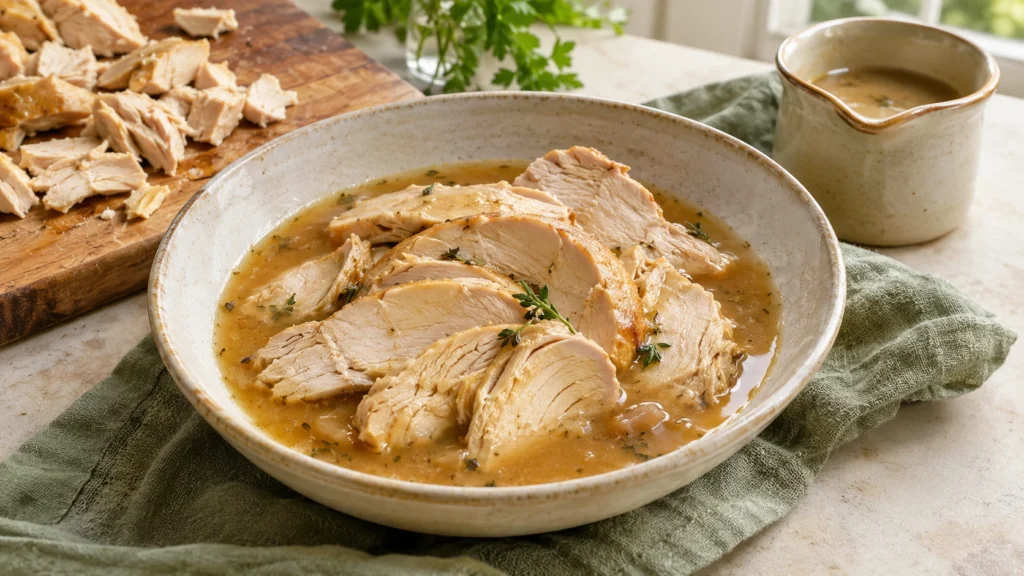
You can make dry cooked chicken more enjoyable, but you cannot restore all the moisture lost in cooking. Test one slice first. Firm, intact meat works best sliced thinly and coated with sauce; crumbly meat is better chopped into a moist filling or soup. Avoid cooking it repeatedly. Rescue only chicken that has been safely cooked and stored, and reheat chilled leftovers to 165°F (74°C).
Test one slice before choosing a rescue
Dry chicken does not have just one texture. The breast you can slice neatly but find difficult to swallow needs a different treatment from a piece that collapses into chalky crumbs when cut. Before opening a carton of broth or starting a second cooking process, examine the meat you have. One test slice tells you whether the main problem is a large dry bite, resistant fibers or a crumbling structure that will not survive more handling.
Use a clean board and a sharp knife. Identify the direction of the grain, then cut one slice across it. Bend the slice gently or separate a small piece. If it holds together, keep that structure and make the portion thinner. If it fractures, plan to chop it rather than insist on serving full slices. If it separates into pleasant coarse strands without much force, it may be a suitable shredded filling. If those strands feel like dry threads, a smaller chopped format is often more comfortable to eat.
A dry result comes partly from the changes in muscle proteins during heating and the accompanying loss of water. Research on poultry meat describes water-holding capacity as an important part of meat quality. Once excess moisture has escaped, a sauce will mostly coat and lubricate the cooked fibers; it is not a time machine that reverses the earlier heating. That distinction matters because it prevents an unsuccessful rescue from turning into another hour of cooking.
For chicken that is already safely cooked, use the dry chicken rescue tool to find ways to serve or repurpose it when it turns out dry.
Quick diagnosis: match the symptom to the next step
| What you notice | Likely explanation | Next step |
|---|---|---|
| Intact but dry slice | Large dry bite | Thin-slice and coat with sauce |
| Crumbly meat | Poor structural cohesion | Chop into a moist filling |
| Long dry strands | Fiber separation | Shorten across grain; sauce gently |
Match thin slicing, chopping or shredding to the dish
For intact slices: add moisture where it matters
Thinly slice the chicken across the grain and arrange it on a warm plate. Spoon gravy, a tomato-based sauce or a compatible pan sauce over the slices. The shorter fibers make each bite easier to chew, while sauce gives the mouth moisture and spreads seasoning. A thick dry breast served uncut in a puddle of sauce often remains disappointing because the eater must still chew a large block of dry flesh. Change the shape as well as the accompaniment.
If you are planning pasta, prepare the pasta and sauce first. Add the sliced chicken at the end rather than simmering it while the sauce reduces. For rice bowls, place slices over a moist base and serve an extra spoonful of sauce at the table. For a sandwich, thin slices and a spread work better than a thick section of breast. A crunchy vegetable can add contrast, but avoid building a sandwich entirely out of dry components such as dry bread and dry chicken.
For crumbly meat: use a chopped format
If the test slice falls apart, don't fight it. Cut the meat into small, reasonably even pieces. Toss with a creamy or tangy dressing for a chilled chicken salad, provided the meat was properly cooked and cooled. Or fold the pieces into a completed pot pie filling, a moist rice dish or a casserole. Chopping distributes the chicken in each bite with the other ingredients. It also reduces the chance that a large dry piece will dominate the texture of the dish.
Choose a binder that fits the dish. A mayonnaise or yogurt-based dressing is appropriate for a cold salad; gravy fits a savory filling; a tomato or chile sauce may be better for a warm dish. Add the binder gradually so that the mixture remains cohesive rather than watery. If the meat is salty already, taste the completed mixture only once you know the chicken is safe. Unsalted broth or a mild sauce can help prevent an overly salty rescue.
For soup or shredded fillings: finish the base first
A soup can absolutely use dry cooked chicken, but add the meat after the vegetables and broth are ready. If it crumbles, diced pieces are preferable to fine shreds. A broth contributes liquid to each spoonful without requiring the chicken to remain in a rolling boil while potatoes, carrots or noodles soften. For tacos or enchiladas, coarse pieces coated with sauce hold up better than finely shredded fibers that have been heated and stirred for a long time.
Suppose you cooked four breasts for dinner and two are quite dry. For tonight, slice one thinly and serve it with sauce. For tomorrow, cool the remaining safely cooked pieces promptly, then chop them for a chicken salad or add them to an already prepared soup. This example gives the meat two different jobs rather than forcing every piece into the same recipe. You can also portion the remaining chicken in a shallow container so you do not reheat the entire batch when you need only one serving.
For your next meal, compare the options in our chicken soup & stew recipes collection and select a method that fits the texture you want.
For a complete recipe to compare against your preparation, see Chicken Soup Recipe from Scratch. Follow the recipe’s actual cut, size and cooking directions rather than assuming the same timing applies to a different preparation.
Change one variable for the next batch
The rescue works around the texture. Prevention addresses the reason it happened. Start with a thermometer and check the thickest part of each piece before the expected cooking endpoint. Remove each breast once it reaches the recommended safe internal temperature instead of waiting for pieces of different sizes to finish together. If the recipe uses a sauce that must reduce, reduce it separately or remove the cooked chicken temporarily; do not keep it in the pan merely to finish the sauce.
Another common factor is the serving plan. Chicken that is destined for tomorrow's salad should not be cooked again simply to make today's dinner warmer. Plan the future use when you portion the batch. Whole pieces generally allow you to choose a cut shape later; fine shreds expose more surface and may lose moisture during storage. Refrigerate promptly in shallow containers instead of waiting for a large batch to sit out until completely cold. Follow the current food safety recommendations for leftover storage and reheating.
A safe rescue is not a safety reset
If your chicken was left out for more than two hours, or more than one hour above 90°F (32°C), discard it rather than hiding it in a strongly flavored dish. Refrigerated leftovers should be used within four days. When reheating, bring leftovers to 165°F (74°C), checking the food rather than assuming a bubbling sauce has heated every piece. Properly chilled, safely cooked chicken may also be served cold in a salad. Reheating cannot make mishandled chicken reliably safe; the decision to rescue texture begins with the storage history.
Build the next meal around the chicken's shape
If a recipe requires attractive whole slices, choose a tender intact piece and use the dry one elsewhere. If a dish relies on a moist filling, use chopped chicken and add just enough binder. If the recipe normally cooks raw chicken in its sauce, don't follow that same timetable with already cooked meat. Cook any raw ingredients fully first, then incorporate the cooked meat and heat safely as needed. This adaptation is particularly useful when using a large recipe collection: identify the role the chicken plays rather than substituting cooked meat blindly for raw.
For broader method and preparation guidance, use our chicken cooking guide.
Sources and references
- FoodSafety.gov — Safe minimum internal temperatures — Thermometer and poultry / stuffing / leftovers safe endpoint.
- FoodSafety.gov — People at risk of food poisoning — Refrigeration time limits, storage and reheating.
- Measuring water holding capacity in poultry meat — Water retention, muscle structure and cooking losses.
Frequently asked questions
Can sauce make dry meat feel juicier?
Yes. A sauce adds moisture and lubrication to each bite, especially when used with thin pieces. It does not restore all the water lost from muscle during overcooking, so the original texture may still be detectable.
Is shredding always the best rescue?
No. Resistant or crumbly breast can become even less pleasant when pulled into fine strings. Chop it and mix with a moist filling instead if a test piece refuses to separate naturally.
Will soaking cooked chicken in broth fix it?
Broth may coat the surface and help serve the chicken in a moist dish. Extended boiling or soaking is not a dependable way to restore lost internal moisture. Make the broth flavorful first, then combine with the chicken.
Can I put dry cooked chicken in soup?
Yes, if its handling and storage are safe. Dice or coarsely shred the chicken, finish the soup base, then heat the chicken as required instead of boiling it throughout the preparation.
Should I slice dry chicken with or against the grain?
Across the grain usually shortens the fibers in each bite and makes dry intact meat easier to chew. If it falls apart, use smaller chopped pieces in a dressing or sauce instead.
Can I rescue dry chicken that has been sitting out all afternoon?
No. Follow the official time limits for perishable food left at room temperature. If the chicken has exceeded those limits, discard it; moisture and seasoning cannot remedy unsafe handling.


